
Industry
Baby food
อาหารเด็ก
Purées and drinks in a spouted pouch that a child holds and a parent has to trust.
The pouch is filled, sealed, and then cooked — steam under pressure, above boiling, with the food already inside. So the film has to leave the retort still sealed, still legible, and still easy to tear open one-handed at a playground.
Nothing inside preserves the food. The pouch does all of it.
Cap size, spout bore and tamper evidence are chosen with the recipe, not after it — a cap is a choking question before it is a design one.
Sterilised inside the sealed pouch — normal here, not an exception
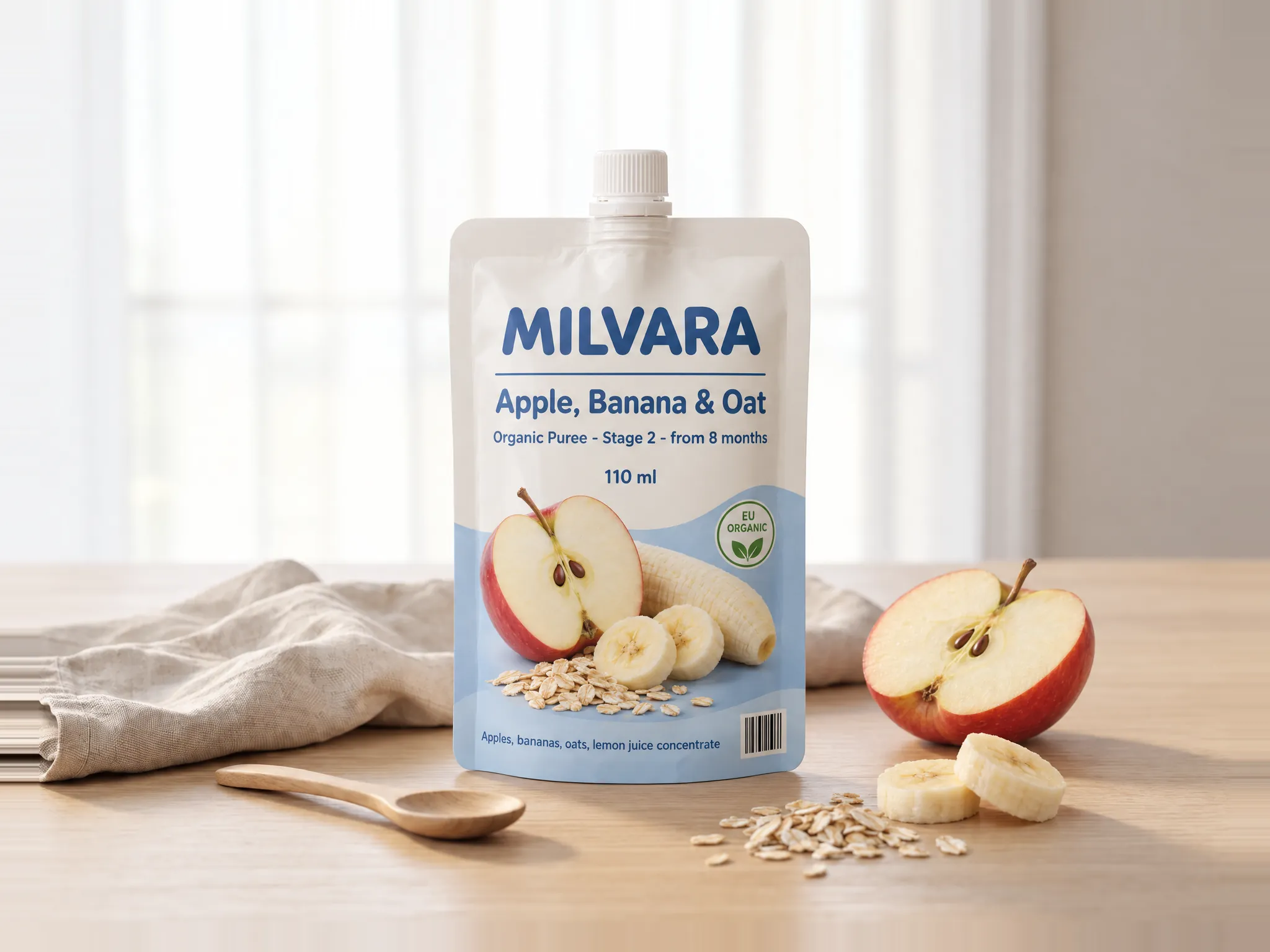
What this category asks of the film
All three at maximum. Nothing inside the pouch preserves the food — the pouch does it alone, unopened, for months.
- Holds air out
- Maximum
Oxygen is what turns oil rancid and takes the colour and the potency out of a product. It is the slowest of the three and the one that decides a shelf life in months rather than weeks.
- Holds damp out
- Maximum
Damp is the fastest of the three to show. Water between the layers delaminates the film, and in Thai humidity a weak film can lose a product in a single wet season.
- Holds light out
- Maximum
Light bleaches pigment and breaks down vitamins, and a clear window lets it through as readily as an open doorway does. It is also the only barrier a buyer can see is missing.
- Takes heat
- xxxWe have not rated this one yet
A retort pouch is cooked with the food inside it, under pressure, above boiling point. A film that survives filling does not automatically survive the retort.
- Takes a knock
- xxxWe have not rated this one yet
Dry pet food and coffee beans have corners. So does a pallet on a lorry. Most failures in transit are one hole, not a whole seam.
- Seals shut
- xxxWe have not rated this one yet
Every barrier above this one is undone by a seal that opens. It is also the layer that has to close cleanly through spilled powder and oil on a filling line running at speed.
- Prints true
- xxxWe have not rated this one yet
The shelf is the only place most products meet a buyer. Gravure prints from an engraved copper cylinder, which is why the same brown holds across a run instead of drifting.
- Goes back
- xxxWe have not rated this one yet
A laminate of three different plastics cannot be recycled as any one of them. A mono-material structure can, and every year it reaches the same shelf life on more of the jobs.
Moisture — a retort cycle is wet heat. Water between the layers delaminates the film, and the pouch fails on the shelf, not in the plant.
Oxygen — vitamin C and colour go first. A parent who sees a brown purée puts it back.
Light — it breaks vitamins down behind a clear window as fast as in daylight.
Heat is the fourth, and the one we have not rated yet.
Shapes that suit it
One shape does nearly all of this category.
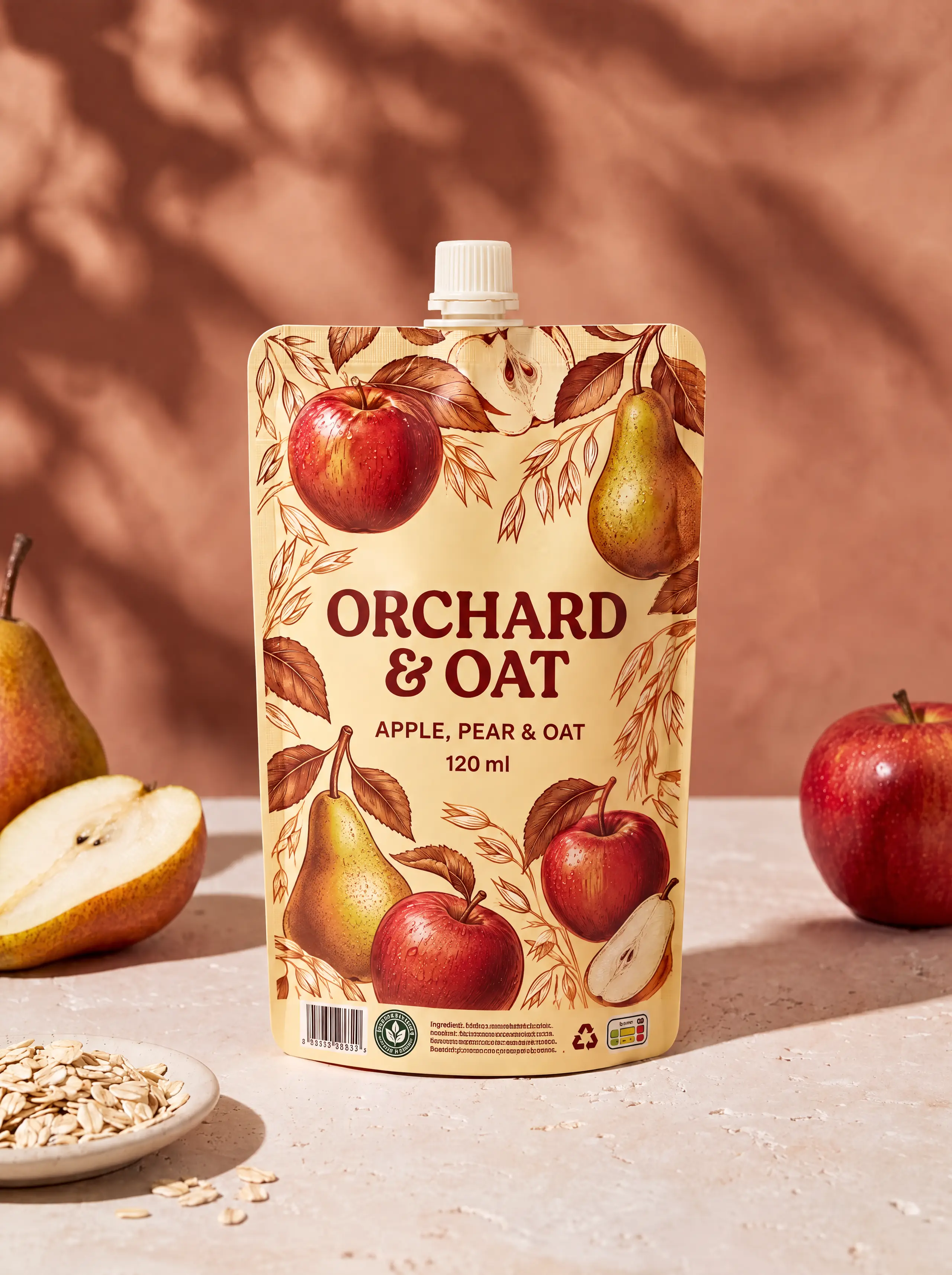
We fill 30 ml – 2 L on this shape. Baby purées usually sit between 90 and 150 ml; two litres is a food-service refill.
Cap diameter is chosen for choking safety first, then for your filling line.
Structures a quote would start from
Read straight off the barrier levels above: these are the laminates that meet all three. The final structure is chosen with your product, your shelf life and your filling line in the room.
PET / NY / AL / RCPP
- PETOuter face — takes the print and the knocks
- NYToughness — takes the puncture and the drop, not the barrier
- ALBarrier — real aluminium foil, the highest barrier there is
- RCPPSealant — holds its seal at retort temperature
RetortThe retort grade, and where this category starts. PET carries the print, nylon takes the puncture and the drop, aluminium foil takes oxygen, moisture and light to effectively zero, and the RCPP sealant holds through 121 °C for xxx minutes with the purée inside.
Our plant builds this today.
See this category on the formula sheetPET / AL / PE
- PETOuter face — takes the print and the knocks
- ALBarrier — real aluminium foil, the highest barrier there is
- PESealant — melts to itself to close the pouch
Same barrier, cheaper sealant, no retort. Use it only if the product is hot-filled or chilled, never if it is cooked in the pouch.
Industry standard, not yet confirmed here
See this category on the formula sheet
The four figures asked first
Where production has signed a number, it is printed. Where it has not, the row stays blank — better a blank than a guess you would hold us to.
- Lead time, first run
- 20 – 45days from the layout you signed at Step 3
- Minimum order
- xxx(metres of film, or pouches; we can quote either)
- Colours in one pass
- xxx
- Size and seal tolerance
- xxxmm
Questions
What buyers ask before they order
- Can it keep moisture out, keep light out, hold a vacuum, take a retort?
Tell us what the pack has to survive and the film spec is built for it. That covers vacuum, and retort for a pouch that has to take pressure and heat and come out of a boiling or steaming cycle intact.
- Can you run food and cosmetics work, and can you certify it?
Yes, for every industry — the line runs food-grade film from end to end. A certificate of analysis (COA) goes out with every production lot and every delivery.
- What are you certified to?
ISO 9001:2015, GHPs, HACCP and BRC/IoP, all certified by BSI.
Configure a pouch
A quote request, not an order — nothing is bought and nothing is charged.
Have these to hand
- What goes in the pouch, and how much per pouch
- Roughly how many pouches, and by when
- Cap and spout — the diameter you need, or the filler you already run
- Artwork if you have it — a sketch is enough to start
We answer within two working days.